

Healthcare decisions work differently from ordinary purchases.
Someone might buy a shirt after seeing a good photo.
Eye care requires more trust.
A patient may be worried about cataracts.
A parent may be researching their child’s eyesight.
Someone might have questions about glaucoma, AMD, dry eye, progressive lenses, or treatment options.
Before they ask:
“How much?”
they may first ask:
“What does this mean?”
“Should I be worried?”
“What are my options?”
“Who can I trust?”
That makes education part of the marketing journey.
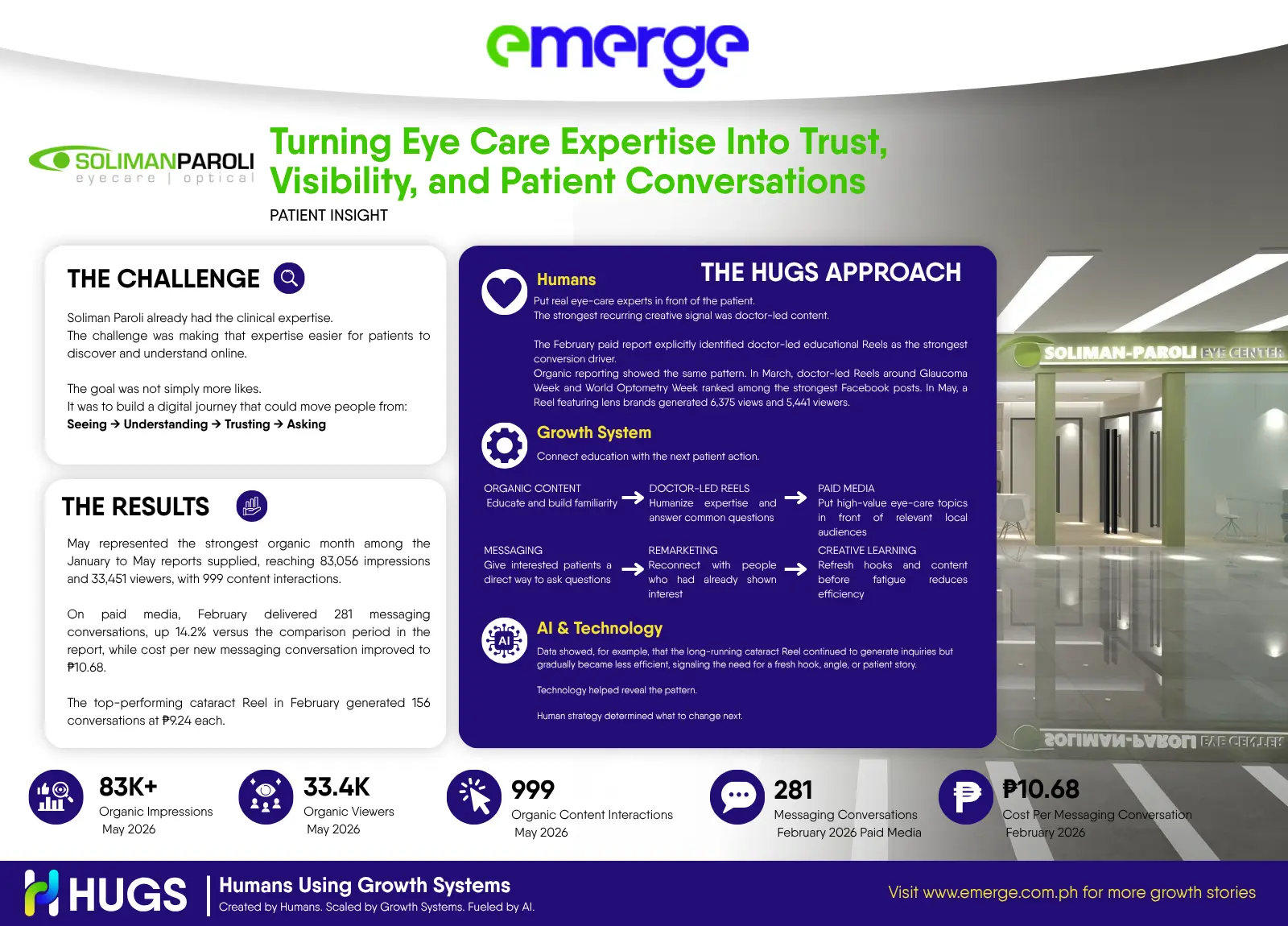
For Soliman Paroli Eyecare Optical, Emerge’s strategy was built around that reality.
The goal was not simply to publish eye-care content.
It was to connect expertise, trust, visibility, and patient inquiry into one system.
Soliman Paroli already had something highly valuable:
real clinical expertise.
The challenge was getting more of that expertise in front of the right people in a way they could understand.
Generic educational graphics could explain symptoms.
Promotional posts could communicate offers.
But neither alone created the strongest digital journey.
The opportunity was to let patients see and hear directly from the professionals providing the care.
That led to a bigger strategy:
Turn doctors into trusted digital educators.
Then connect that trust with a clear next step.
Healthcare marketing is fundamentally human.
Patients may understand that a clinic offers cataract treatment.
But hearing a doctor explain the procedure can reduce uncertainty in a way that a static ad cannot.
The paid performance reports make this especially clear.
In February 2026, the strongest highlighted ad was a doctor-led cataract Reel.
It generated:
The February report concluded that doctor-led educational Reels remained the strongest conversion driver.
That finding shaped the recommendations for future campaigns, including new doctor explainers around AMD, glaucoma, dry eye, and ICL.
The lesson was not simply:
Use more videos.
It was:
Let the expert explain the problem directly.
Yes.
The organic reports show that audiences also responded to expertise-led content outside paid advertising.
In February, an AMD Awareness Reel generated
A Low Vision Awareness Reel also ranked among the top posts.
In March, doctor-led content around Glaucoma Week and World Optometry Week ranked among the strongest organic Facebook posts.
By May, a doctor-led Brands of Lenses Reel generated
ranking second for the month.
Different topics.
Same underlying principle:
Human expertise travels well in short-form content.
Organic content had a different job from paid ads.
It helped create familiarity before someone had an immediate reason to inquire.
The content ecosystem included:
This mattered because patients are rarely ready to inquire the first time they encounter a clinic.
Someone might see an educational Reel today.
A month later, they see a post about lenses.
Later, they see a doctor credential or clinic certification.
Eventually, when an eye-care need becomes urgent, the brand is already familiar.
That is why organic content and paid conversion campaigns should not be treated as completely separate activities.
Organic helps build the trust pool.
Paid media helps capture intent.
The monthly organic reports show a strong rebound by May.
Then May reached:
The May report represents the strongest organic visibility period in the supplied January to May set.
Content interactions also reached 999, up from 811 in April.
May’s strongest content reveals something useful about healthcare authority.
The top post was not a generic eye-health tip.
It highlighted Soliman Paroli’s status as a:
Certified Essilor Stellest Expert Clinic.
That post generated:
The second-ranked post was the Brands of Lenses Reel, which generated
The third highlighted Dr. Mark’s BCLA Fellowship, generating
All three have something in common.
They reinforce expertise and credibility.
That is an important healthcare marketing insight.
Patients don’t only want health tips.
They want reasons to trust who is providing the care.
Organic marketing created awareness and familiarity.
Paid media gave interested patients a more direct action:
Send a message.
February showed the strongest paid conversion performance among the supplied monthly summaries.
The account generated:
with a reported:
The report also showed a
while cost per conversation improved by
That is the more commercially relevant outcome.
The content did not stop at views.
It helped start actual patient conversations.
Cataracts are a high-relevance problem for older audiences and their families.
The paid audience data consistently showed meaningful representation among older age groups.
In February, people aged
of the reported ad audience, while
By May, the
of the reported paid audience.
The doctor-led cataract Reel matched that audience need with something very practical:
information from a trusted expert.
The creative did not rely solely on a promotional offer.
It helped explain the procedure.
That likely made the message more useful to someone already worried about cataracts.
One of the most useful lessons in the Soliman Paroli reports is that even winning creative eventually fatigues.
The cataract Reel remained the top highlighted creative across multiple paid reports.
In January, the creative was associated with
on the ads-performance page.
In February, it generated
In March, it generated
In April, it generated
By May, it generated
The May report explicitly identified the issue: the same creative had been running since February 2025 and was showing declining efficiency, suggesting that the creative and warm audience were approaching exhaustion.
That is a very useful Growth System lesson.
A successful campaign is not something you simply leave running forever.
Performance has to be monitored.
This is where analytics becomes strategic.
Technology can reveal:
Conversation volume is declining.
Cost per conversation is rising.
The same audience has seen the creative repeatedly.
Clicks may still be increasing while conversion efficiency weakens.
In May, for example,
yet messaging conversations remained almost flat and cost per conversation increased.
Without a connected view of the funnel, a team might conclude:
“The campaign is improving because engagement is up.”
But the commercial signal says something different.
More people were interacting.
That did not translate into proportionally more conversations.
The Growth System therefore asks:
Where is the bottleneck now?
That is a better question than simply asking whether reach or engagement increased.
Remarketing was used to reconnect with people who had already demonstrated interest.
In April, the remarketing ad set generated
By May, the same remarketing approach generated
Again, the trend showed declining efficiency.
The May recommendation was therefore not:
Spend more on the same audience.
It was to rebuild the remarketing strategy and refresh the creative pool with a new angle.
This illustrates a core HUGS principle.
Growth Systems are not static automations.
They require human interpretation and continuous improvement.
The organic audience remained highly relevant geographically.
Across the reports, the strongest locations repeatedly included:
Angeles City
San Fernando
Mabalacat City
Quezon City
Manila
Mexico
Porac
Tarlac City
Magalang
Caloocan
The reports specifically noted that most fans were located in Pampanga and key areas across Central Luzon and NCR.
For a healthcare provider with a physical service area, that matters.
A million views from irrelevant locations might look impressive.
A smaller but geographically relevant audience may be more valuable.
Doctors provide the expertise, judgment, credibility, and reassurance that patients need.
Organic education, short-form video, paid messaging campaigns, remarketing, audience targeting, and monthly performance analysis work together instead of operating independently.
Analytics reveal changing audience behavior, creative fatigue, cost trends, content opportunities, and where the patient journey needs improvement.
Together:
Created by Humans.
Scaled by Growth Systems.
Fueled by AI.
The biggest lesson is not that one cataract Reel generated hundreds of conversations.
It is what happened next.
The ad worked.
The team learned from it.
The creative was scaled.
Performance was monitored.
Eventually, efficiency declined.
The system detected the change.
The next recommendation was to refresh the creative and remarketing strategy.
That is how sustainable digital marketing works.
Not:
Find one winning ad and keep spending.
But:
Find what works. Understand why. Scale it. Watch the data. Refresh before the system breaks.
Start with expertise.
Make that expertise easy for patients to understand.
Use real professionals whenever possible.
Build organic content that earns familiarity and trust.
Use paid media to convert relevant interest into conversations.
Remarket to people who already know you.
Track the entire journey rather than one vanity metric.
And when a successful creative begins losing efficiency, don’t assume more budget will fix it.
Create the next reason for patients to pay attention.
That’s the HUGS approach.
A strong healthcare digital presence should help people:
Discover you.
Understand you.
Trust you.
Reach you.
When those stages work together, marketing becomes more than content.
It becomes a Growth System.
Get your FREE Growth Score.
Doctor-led educational content repeatedly performed well across both organic and paid media. The reports highlighted cataract, AMD, glaucoma, lens education, and professional expertise content among the strongest-performing formats.
February 2026 generated
, the strongest monthly conversion figure among the supplied paid reports.
The doctor-led cataract Reel was consistently the top highlighted paid creative. In February, it generated
Its efficiency declined over time. The highlighted cost per conversation increased from
while conversation volume for the creative fell from 156 to 97. The May report identified creative and warm-audience exhaustion as the issue.
HUGS combines human medical expertise, connected systems for content and patient acquisition, and AI-assisted performance analysis. The doctors remain the source of expertise, the Growth System connects the patient journey, and technology helps improve decisions over time.

Typically replies within a day
Hello, Welcome to the site. Please check below button for chatting me through viber.