
Healthcare decisions increasingly begin before a patient walks into a hospital.
Someone notices a symptom.
A family member searches for information.
A patient wants to understand a medical procedure.
Someone needs to know where a particular diagnostic service is available.
Others simply want reassurance that a healthcare provider is accessible, active, and trustworthy.
That means a hospital’s digital presence isn’t simply another marketing channel.
It is part of the patient information journey.
For Our Lady of Mt. Carmel Medical Center – Clark, the opportunity was to build a stronger connection with the surrounding community through useful, consistent, and human-centered healthcare content.
Emerge approached that challenge using HUGS: Humans Using Growth Systems.
OLMCMC–Clark was strengthening its capabilities, facilities, services, and medical team.
But physical growth also needed digital visibility.
Patients cannot consider a service they don’t know exists.
They may not ask about a procedure they don’t understand.
And healthcare institutions can lose opportunities to build trust when their digital presence doesn’t reflect what is actually available inside the hospital.
The challenge therefore went beyond increasing followers.
The hospital needed a digital presence capable of supporting several outcomes:
Awareness.
Make more people familiar with the hospital and its capabilities.
Education.
Help patients understand health concerns, procedures, preventive care, and available services.
Trust.
Communicate healthcare information clearly and responsibly.
Local relevance.
Stay visible among communities surrounding Clark and Pampanga.
Action.
Give people reasons to seek more information or connect with the hospital when care is needed.
Healthcare marketing cannot be treated like ordinary promotional advertising.
Behind every search, click, comment, or inquiry may be a person concerned about their own health or someone they care about.
That changes how content needs to be created.
Instead of beginning with:
“What does the hospital want to promote?”
The stronger question becomes:
“What does the patient need to understand?”
This helped shape content around practical health education, preventive care, symptoms, procedures, diagnostics, treatment options, and healthcare awareness campaigns.
The hospital’s performance reports provide strong evidence that audiences responded to this approach.
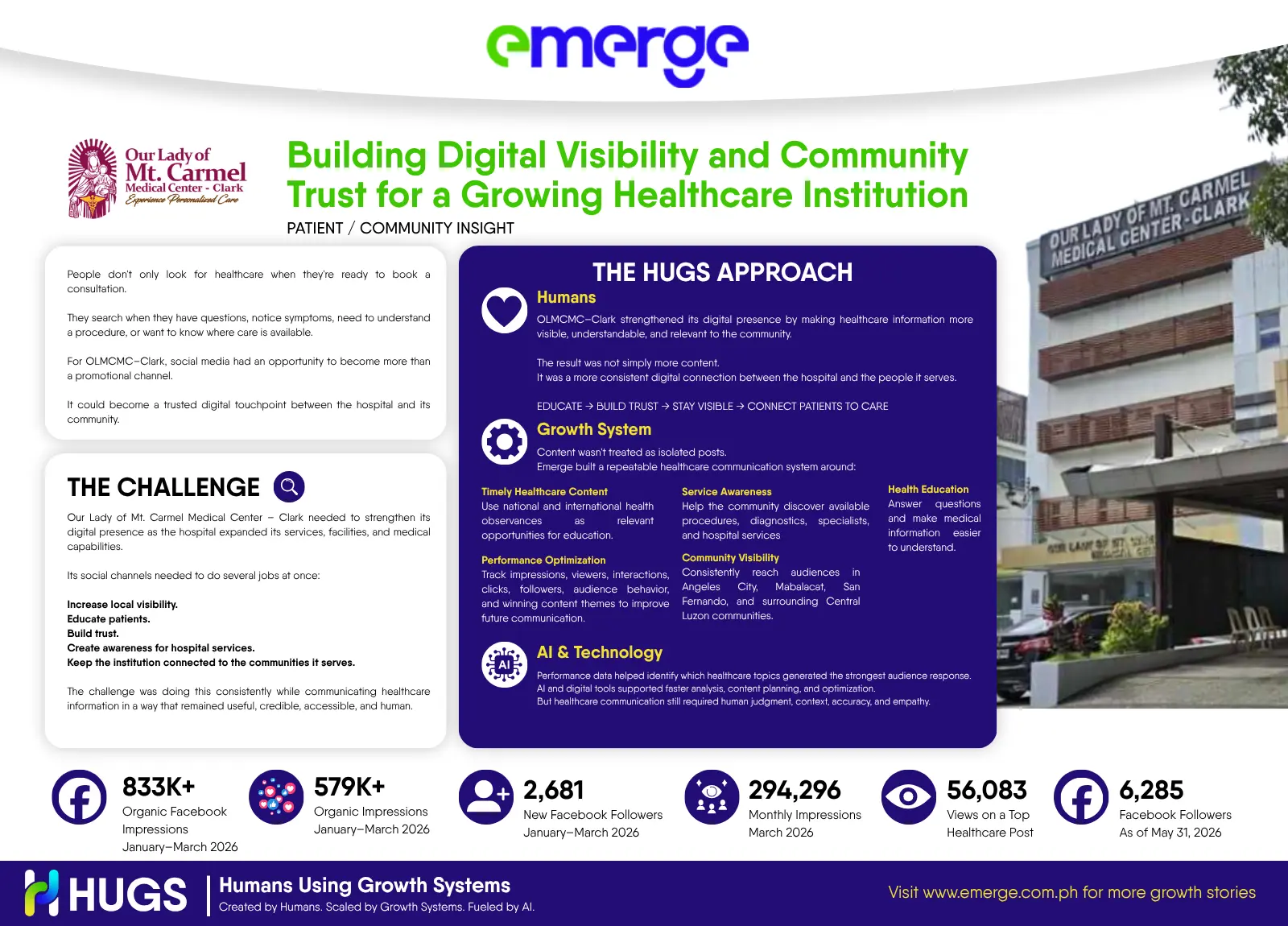
In January, content around Cervical Health Awareness Month generated 14,933 views and reached 11,006 viewers. World Leprosy Day generated another 12,028 views.
February’s strongest-performing Facebook content included 24-Hour Ambulatory Blood Pressure Monitoring, which generated 10,278 views, while educational posts around 12-Lead ECG and 2D Echo also ranked among the month’s strongest posts.
Then March demonstrated how strongly relevant healthcare education could perform.
A Women’s Month Reminder generated 56,083 views and reached 37,036 viewers.
A Pap Smear post generated 38,764 views, reached 27,314 viewers, and recorded 1,315 interactions.
These weren’t entertainment posts designed simply to chase engagement.
They were healthcare topics people had a reason to care about.
The first-quarter reports show a clear expansion in organic visibility.
March alone was more than double January’s reported level.
That growth matters because healthcare visibility is often cumulative.
A person may see an educational post today without needing the hospital immediately.
But that interaction contributes to familiarity.
When that person eventually needs a consultation, diagnostic procedure, rehabilitation service, emergency care, or another healthcare service, familiarity can influence which institution comes to mind.
Yes.
For a healthcare institution, those followers represent more than a social-media vanity metric.
They create a growing community the hospital can continue reaching with healthcare education, service information, announcements, physician-related content, and preventive health messages.
The reports consistently showed the hospital reaching the communities most relevant to its physical location.
Angeles City ranked as the leading location, followed by areas including Mabalacat and San Fernando, with other Central Luzon communities also represented.
That is strategically important.
A hospital doesn’t necessarily need nationwide social reach.
It needs meaningful visibility among people who can realistically access its healthcare services.
The data indicated that the digital audience was developing around the hospital’s actual regional market.
One of the clearest lessons from the campaign was that specific, useful healthcare information can outperform generic institutional content.
In March, the Women’s Month Reminder and Pap Smear content were major performers.
In May, the strongest posts included Shockwave Therapy, Arthritis Awareness Month, and Hepatitis Awareness Month. Arthritis content generated 19,171 views and 1,202 interactions, while Shockwave Therapy generated 23,762 views.
The pattern suggests an important principle for healthcare content:
Specificity creates relevance.
“Take care of your health” is broad.
Explaining Pap smears, ambulatory blood pressure monitoring, arthritis, hepatitis, ECGs, or shockwave therapy gives people something concrete to understand.
That makes the content more useful.
And useful healthcare content builds trust.
AI can make healthcare marketing teams faster.
It can help analyze performance data, identify recurring audience interests, organize content opportunities, accelerate research workflows, and support content planning.
But healthcare is also exactly where AI-only marketing becomes risky.
Medical communication requires context.
It requires careful review.
It requires understanding what should and shouldn’t be simplified.
And most importantly, it requires remembering that there is a person behind the screen.
That’s why Emerge uses AI as a multiplier rather than the strategist.
Humans provide judgment and empathy.
Growth Systems provide consistency and structure.
AI helps scale the work.
The biggest outcome wasn’t one viral post.
It was the creation of a stronger and more consistent digital healthcare presence.
More people were seeing the hospital’s content.
The Facebook community was growing.
Healthcare education generated meaningful engagement.
Service-related topics created awareness.
And the hospital was increasingly visible among audiences in Pampanga and surrounding communities.
That creates a foundation for something larger than social-media performance.
It creates digital trust.
Hospitals and clinics don’t need to turn healthcare into entertainment to succeed on social media.
They need to become useful.
Explain the questions patients already have.
Show the services patients may not know exist.
Make complex medical information easier to understand.
Connect awareness topics with real healthcare actions.
Stay consistently visible in the communities you serve.
And use performance data to understand which topics matter most.
The objective isn’t simply:
Post more.
The objective is:
Educate → Build Trust → Stay Visible → Connect People to Care
That is how social media becomes part of a healthcare Growth System.
A patient may discover your clinic or hospital through Facebook.
Another may search Google.
Someone may visit your website.
Someone else may send a Messenger inquiry.
The challenge is making those touchpoints work together.
Because marketing shouldn’t end when someone sees a post.
It should help people move toward the information, service, appointment, or care they need.
That’s the opportunity behind a connected healthcare Growth System.
Find out where your healthcare marketing can grow.
Healthcare social media marketing uses digital content to educate communities, communicate available services, strengthen brand visibility, build patient trust, and help people discover appropriate healthcare resources. Effective healthcare content should prioritize accuracy, relevance, clarity, and responsible communication.
The OLMCMC–Clark reports indicate particularly strong performance for specific educational topics such as Pap smears, women’s health, ambulatory blood pressure monitoring, arthritis, hepatitis, ECGs, and treatment-related information. Content that answers a clear patient question or explains a specific health concern tends to provide more practical value than generic awareness messaging.
Organic social media helps hospitals maintain consistent visibility, educate their communities, communicate services, and build familiarity before healthcare needs arise. It also provides ongoing audience insights that can inform future communication and marketing decisions.
Yes, but it should support rather than replace human expertise. AI can assist with analysis, research workflows, planning, and execution, while medical accuracy, context, brand judgment, privacy, and responsible healthcare communication still require human oversight.
A healthcare Growth System connects the touchpoints surrounding the patient journey, including visibility, content, search, website experiences, inquiries, appointment pathways, follow-up, data, and performance measurement. The goal is to make those components work together instead of operating as disconnected marketing activities.

Typically replies within a day
Hello, Welcome to the site. Please check below button for chatting me through viber.