

Patients don’t only encounter doctors inside clinics anymore.
They search.
They scroll.
They watch videos.
They read posts about symptoms they may be experiencing.
They look for information before deciding if they should seek professional help.
This creates an opportunity for doctors to educate patients before the consultation even begins.
But being visible isn’t enough.
In healthcare, visibility has to lead to something more valuable:
Trust.
For Dr. Gan Kam Ling, the strategy wasn’t simply to publish more women’s health content.
It was to create a digital presence where medical expertise, education, personality, and professional credibility worked together.
That became the foundation of the HUGS approach.
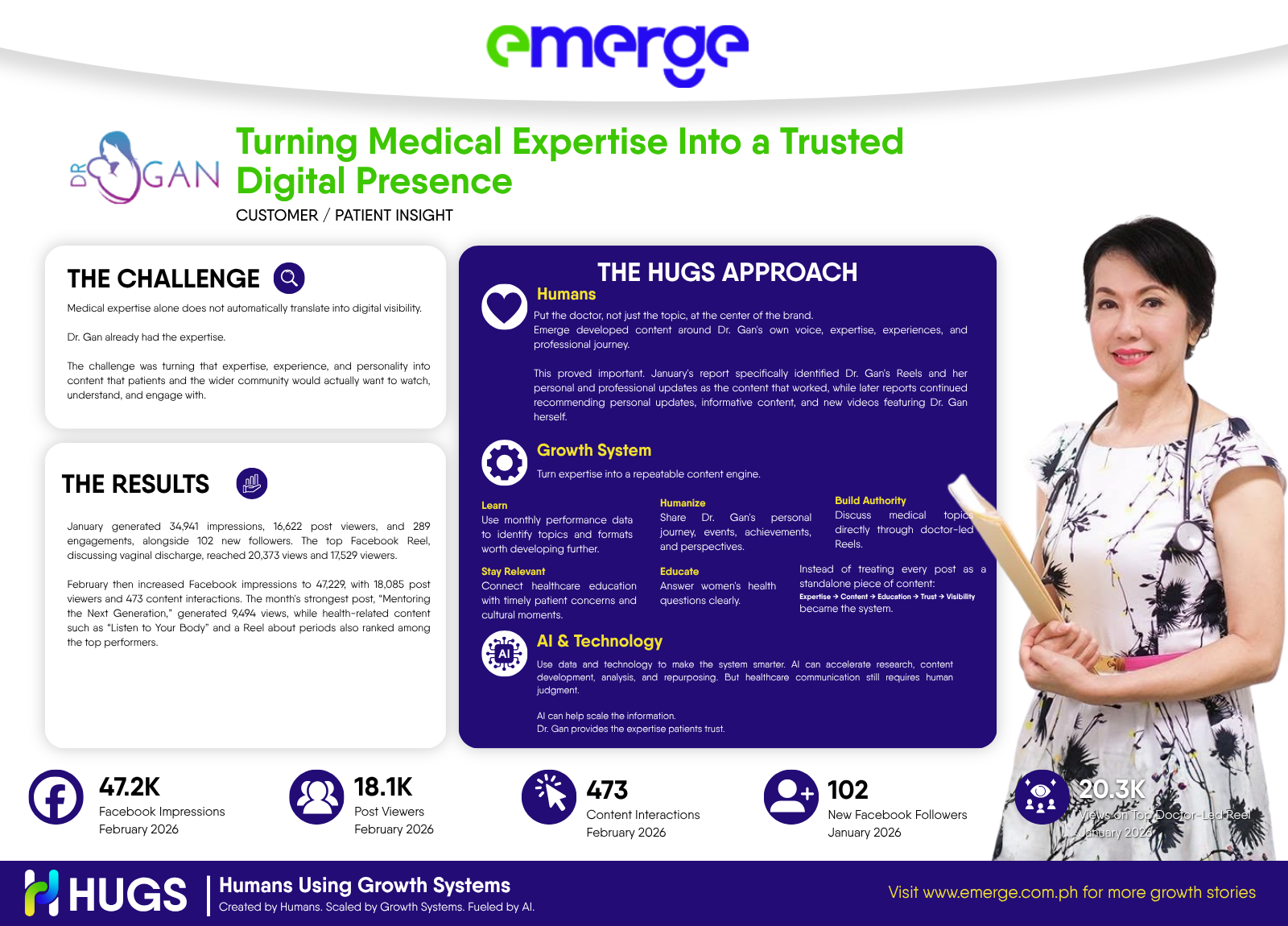
Healthcare professionals already possess something many brands spend years trying to develop:
Expertise.
But expertise does not automatically become effective content.
Medical topics can be complicated.
Some are sensitive.
Some are difficult for patients to discuss.
And when healthcare content becomes too clinical, people may scroll past before understanding why it matters.
The challenge was therefore not finding things for Dr. Gan to talk about.
The challenge was translating what she knew into content people could understand and trust.
The first principle was simple:
Let people hear from Dr. Gan herself.
The January performance report gave a clear signal.
The month’s top three Facebook posts were all doctor-led Reels.
A Reel about menopause generated
A Reel about microwave ablation generated
The month’s strongest Reel, discussing vaginal discharge, generated
The difference matters.
It showed that audiences were willing to engage with health topics when the information came directly through Dr. Gan’s voice and presence.
The report’s action plan reached the same conclusion: Dr. Gan’s Reels were top performers, while personal and professional updates helped keep followers engaged.
Healthcare is personal.
A static graphic can explain a condition.
A doctor can explain it and build confidence at the same time.
Patients can hear the tone.
They can see the person.
They can understand how the doctor communicates.
That creates something a generic healthcare infographic struggles to reproduce:
Familiarity.
Familiarity does not replace medical credentials.
It helps make those credentials accessible.
Women’s health topics gave Dr. Gan opportunities to answer questions patients may hesitate to ask.
Content covered subjects including menopause, periods, vaginal discharge, irregular periods, PCOS, UTI, womb health, body changes, RSV, and adolescent health.
Not every piece needed to be clinical.
Personal milestones, events, mentoring, cultural moments, and Dr. Gan’s professional journey helped audiences understand the person behind the expertise.
February’s strongest Facebook post was “Mentoring the Next Generation,” generating
That is an important signal.
People weren’t interested only in symptoms and treatments.
They were also interested in Dr. Gan.
Doctor-led Reels created a natural format for explaining complex or sensitive subjects.
Instead of asking the audience to read dense medical copy, the doctor could explain the issue directly.
The content also connected with cultural events, celebrations, and topics relevant to Dr. Gan’s community.
In March, a Chinese New Year post became the month’s strongest Facebook content with
while an Indonesian feature and menopause content also ranked among the top three.
April’s strongest posts similarly included Qingming and Tamil New Year content.
This gave the brand another dimension beyond medical education:
community connection.
January 2026 was a major growth month.
The Facebook page generated:
February built on that visibility.
The page generated:
Taken together, January and February generated more than
More importantly, the performance data began showing which type of content deserved greater emphasis.
The pattern across the reports is useful.
In January:
Doctor-led Reels performed strongly.
In February:
Professional journey content, relatable health messaging, and Reels performed strongly.
In March:
Personal achievements and informative, relatable content were identified as effective.
In May:
New treatments, informative content, personal updates, and event invitations were identified as the content that worked.
That gives us a clearer content formula:
Medical Expertise + Human Presence + Relevant Education + Personal Journey
Not every post needs all four.
But the overall content ecosystem does.
One of the useful things about a Growth System is that it does not assume every post will perform.
It learns.
For example, March’s irregular-period post generated only 183 views and one engagement, despite the topic being medically relevant.
In April, reported posts about UTI and PCOS also generated relatively limited organic performance.
That does not mean those subjects are unimportant.
It means topic relevance alone doesn’t guarantee attention.
Packaging matters.
Format matters.
The opening hook matters.
Timing matters.
And in Dr. Gan’s case, having Dr. Gan herself explain the topic can matter.
This is the difference between having a content calendar and having a content system.
A calendar asks:
What should we post?
A Growth System asks:
What are we learning about how our audience wants to receive this information?
AI can dramatically speed up parts of healthcare marketing.
It can help teams:
But there is an important boundary.
AI does not replace the doctor’s expertise.
And it should not replace the judgment required when communicating sensitive health information.
For Dr. Gan, the most valuable source of content remains:
Dr. Gan herself.
Her expertise.
Her clinical perspective.
Her experiences.
Her voice.
Her professional judgment.
AI helps the system work faster.
It doesn’t become the doctor.
One of the more interesting findings is that content did not have to be strictly educational to strengthen Dr. Gan’s positioning.
In February, “Mentoring the Next Generation” became the strongest post.
In March, the report recommended continuing updates about Dr. Gan’s personal journey and achievements.
In May, personal updates and event invitations were again identified as effective, with the report recommending more journey updates and new videos of Dr. Gan discussing important topics.
That tells us something important about doctor personal branding:
Authority becomes stronger when people can see the human being behind it.
Patients don’t need to know every detail of a doctor’s life.
But seeing the doctor’s work, values, achievements, community involvement, and perspective helps turn credentials into a recognizable reputation.
The lesson isn’t that every doctor should become an influencer.
The goal is not popularity for its own sake.
The goal is to make genuine expertise easier for the right people to discover and trust.
For healthcare professionals building their digital presence:
Answer the questions patients are already asking.
Use your own voice whenever possible.
Explain difficult subjects simply without oversimplifying the medicine.
Show professional milestones and meaningful parts of your journey.
Use short-form video to make expertise more accessible.
Track what audiences respond to.
Use AI to accelerate the process, not replace your judgment.
Most importantly:
Build trust before the patient ever walks into the clinic.
For doctors, the value of digital marketing should not be reduced to likes.
The bigger opportunity is digital trust.
Someone sees a Reel today.
Later, they see another explanation from the same doctor.
They recognize her name.
They learn something useful.
They begin associating that doctor with a specific area of expertise.
Eventually, when they or someone they know needs professional care, that familiarity can influence who comes to mind.
That is why consistent healthcare content can become more than social media activity.
It can become part of a doctor’s long-term reputation.
Dr. Gan already had the medical expertise.
The Growth System helped make more of that expertise visible, understandable, and human online.
That’s the opportunity for healthcare professionals today.
Not to become content creators first.
But to make the knowledge they already possess work harder.
Human expertise creates the trust.
Growth Systems create consistency.
AI helps multiply the impact.
That’s HUGS.
Get your FREE Growth Score.
Social media gives doctors a way to educate audiences, answer common questions, demonstrate expertise, and build familiarity before a potential patient reaches out. It should complement professional medical care, not replace consultation or individualized medical advice.
Doctor-led Reels, relatable women’s health education, professional updates, personal journey content, and culturally relevant posts repeatedly appeared among the strongest performers or strategic recommendations in the supplied reports.
In January 2026, a Reel discussing vaginal discharge generated 20,373 views, 17,529 viewers, and 120 engagements, making it the strongest Facebook post reported that month.
AI can assist with research, ideation, organization, repurposing, and analysis, but medical claims and patient-facing health information should remain under appropriate human professional review. The doctor’s expertise and judgment should remain the authoritative source.
HUGS stands for Humans Using Growth Systems. In healthcare, it means putting human expertise and patient understanding at the center, building systems that consistently distribute and learn from that expertise, and using AI to make the system faster and smarter.

Typically replies within a day
Hello, Welcome to the site. Please check below button for chatting me through viber.