

For an airport, social media shouldn’t only tell people where they can fly.
It should help them travel.
A passenger might encounter an airport’s digital channels at several points in their journey.
They may be looking for a destination.
They may need transportation information.
They may want to know what the terminal looks like.
They may be checking for a new route.
They may simply want reassurance that traveling through the airport will be convenient.
That makes airport social media fundamentally different from ordinary brand content.
It is part marketing channel, part information service, part customer experience platform, and part community.
For Clark International Airport, the opportunity was to connect these roles into a more useful digital presence.
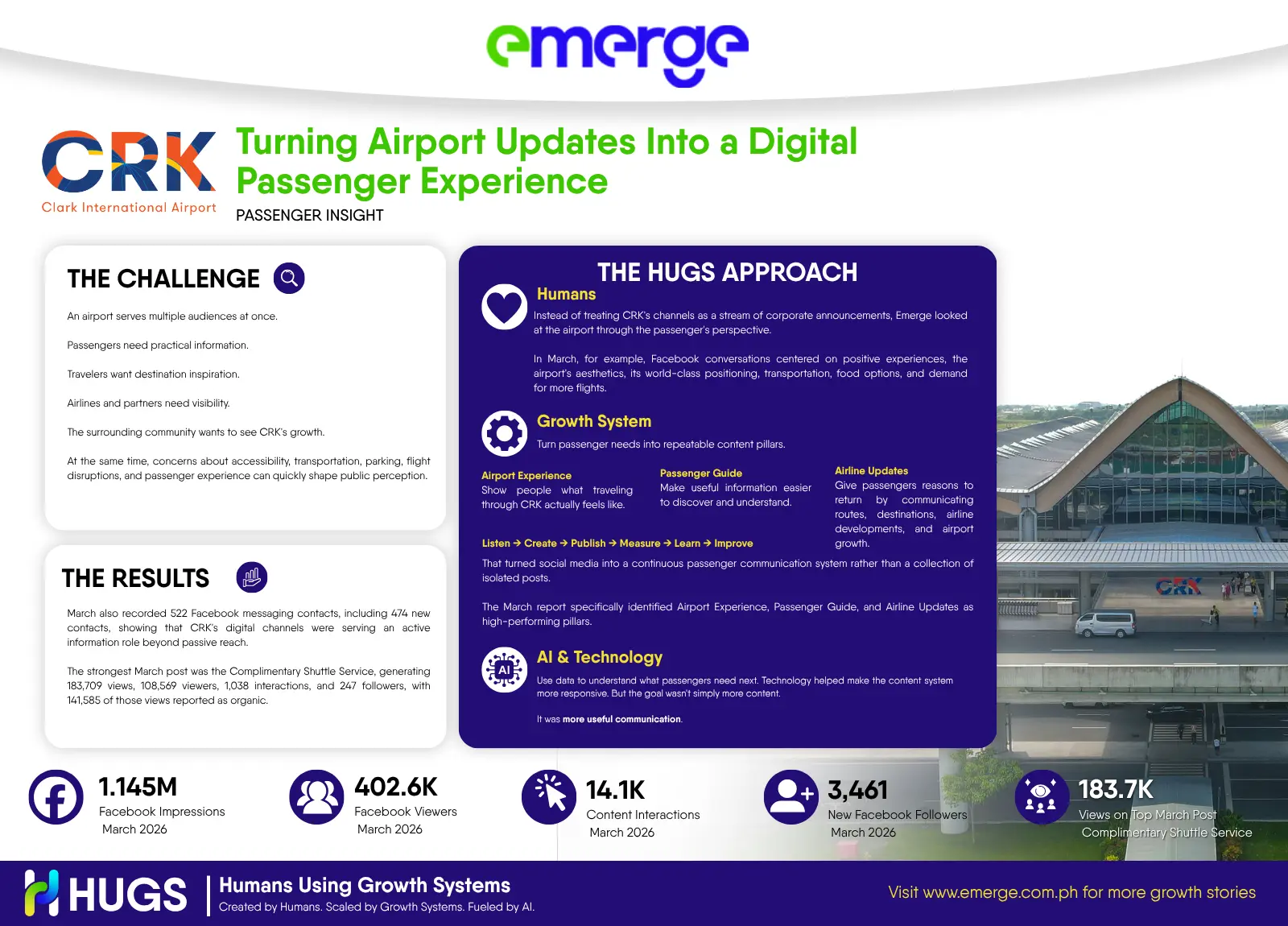
CRK serves a complex audience.
There are leisure travelers.
Business travelers.
OFWs and their families.
People living in Central and Northern Luzon.
International visitors.
Airlines.
Transport providers.
Airport partners.
And people who may still be deciding if Clark is the right airport for their next trip.
Each audience has different questions.
That means an airport cannot rely on one type of content.
Constant promotional posts risk becoming repetitive.
Corporate announcements can feel distant.
Destination content may generate interest but leave practical questions unanswered.
Service information may be useful but needs the right format to reach enough people.
The solution was to stop thinking about posts individually and start thinking about the passenger journey as a content system.
The first part of HUGS is Humans.
For CRK, that meant understanding what real travelers cared about.
Performance and sentiment data gave Emerge a continuous view of those concerns.
In January 2026, conversations included check-in speed, convenience, CRK as an alternative to Manila, parking, delayed flights, accessibility, Cebu Pacific, and turboprop operations.
By March, positive passenger experiences, the airport’s design, its world-class positioning, the silent airport concept, more flights, food options, and Cebu Pacific cancellations were among the conversations appearing around CRK.
This matters because content strategy becomes stronger when it starts with:
What are passengers already asking, experiencing, praising, or questioning?
Instead of guessing what audiences wanted, those signals could help shape the next content cycle.
Individual viral posts are useful.
A repeatable system is more valuable.
CRK’s organic strategy developed around several complementary content roles.
People want to see what traveling through an airport actually feels like.
Terminal architecture, convenience, check-in experiences, ambiance, facilities, passenger POVs, and airport moments helped audiences visualize the CRK experience.
This became especially clear in April, when the “This airport feeling” Reel topped both Facebook and Instagram. The report identified emotional, experiential Reels as a strong audience fit.
Some of CRK’s most powerful content was practical.
Passengers need answers about transportation, parking, navigation, airport services, and travel procedures.
In March, a Complimentary Shuttle Service post became the month’s strongest Facebook content.
It generated:
Of those views,
The lesson was significant.
Utility itself could become compelling content.
New flights create natural demand because they give audiences a tangible reason to imagine their next trip.
In March, a Cebu Pacific Reel promoting Clark-to-Masbate generated
It also added
The January report similarly found flight schedules and updates to be highly saveable and shareable.
An airport isn’t only a building.
It is a gateway.
Destination content allowed CRK to connect the airport with the experience waiting on the other side of the flight.
That creates a useful bridge:
Destination interest → Route awareness → Airport consideration
Infrastructure and partnership stories gave audiences another reason to engage.
In May, the FedEx groundbreaking post generated
The performance report noted that the post represented tangible airport growth and that this type of progress excited the audience.
Together, these pillars created a system capable of serving different parts of the passenger journey.
March 2026 provided a strong snapshot of CRK’s digital reach.
Facebook generated:
The channel also recorded 522 messaging contacts, of which 474 were new contacts.
That distinction is important.
People weren’t only viewing content.
Some were actively using the channel to communicate with the airport.
Reach tells us how many people encountered the content.
Sentiment tells us something different:
How did people feel about the airport?
In March, Facebook comments were reported as:
Positive sentiment had increased from
Instagram was even stronger:
compared with
By May, Facebook positive sentiment reached 79%, while Instagram remained strongly positive at 78%.
The reports associated positive conversations with themes such as passenger experience, convenience, efficiency, world-class design, aesthetics, and CRK’s quiet or silent airport experience.
This is strategically valuable.
An airport’s reputation isn’t created by advertising alone.
It is also created through the experiences passengers talk about afterward.
The AI and Technology component of HUGS doesn’t mean letting AI decide what an airport should say.
Technology is more valuable when it helps humans understand what is happening faster.
Performance data allowed the team to identify:
For example, March data showed the value of practical service content.
April showed the strength of emotional airport-experience Reels.
May reinforced the performance of snackable Reels, destination content, timely shuttle information, and stories demonstrating airport growth.
That creates a feedback loop:
Listen → Create → Measure → Learn → Improve
This is where Growth Systems become more powerful than a conventional content calendar.
Airports are naturally visual.
Aircraft move.
Passengers move.
Destinations change.
Terminals have scale.
Travel itself creates emotion.
Short-form video allows all of that to be communicated quickly.
By April, cross-platform Reels were outperforming static content on both Facebook and Instagram.
In May, the pattern continued.
The month’s strongest Facebook Reel, featuring Cebu Pacific turboprop content, generated
Another Reel built around the idea of the “next adventure” generated
The takeaway isn’t simply “make more Reels.”
It’s:
Use the format that best communicates the experience.
Travel creates uncertainty.
Where do I go?
How early should I arrive?
Where can I park?
Is there a shuttle?
What route does the bus take?
What flights are available?
Every useful answer removes a small piece of friction.
That means service content performs two jobs simultaneously.
It creates engagement.
And it improves the passenger experience.
CRK’s Complimentary Shuttle Service performance is a strong example.
A post that might traditionally be viewed as a routine operational announcement became one of the strongest content assets of the month.
That led the March report to recommend expanding into more:
Useful content wasn’t separate from marketing.
Useful content was the marketing.
The CRK case highlights a principle relevant beyond aviation.
Organizations with large customer journeys shouldn’t build content around what the organization wants to announce.
They should build content around what the customer needs to accomplish.
For an airport, that might mean:
Discover a destination.
Understand a route.
Plan transportation.
Navigate the terminal.
Enjoy the experience.
Share the journey.
Each stage creates a content opportunity.
When those opportunities are connected, social media becomes more than an awareness channel.
It becomes part of the experience itself.
For CRK, the framework can be summarized simply.
Understand passenger questions, travel behavior, experiences, frustrations, and aspirations.
Turn those insights into repeatable content pillars, publishing workflows, community management, measurement, and continuous optimization.
Use analytics, sentiment data, performance insights, and technology to identify patterns and improve decision-making.
Together:
Created by Humans.
Scaled by Growth Systems.
Fueled by AI.
Clark International Airport physically connects people to destinations.
Its digital presence can begin that connection much earlier.
A traveler might first discover a destination through a Reel.
Another might learn about a new route.
Someone else might save a shuttle guide.
A passenger might see the terminal and decide CRK looks easier for their next trip.
Another might message the page with a question before leaving home.
These interactions happen before the boarding pass is scanned.
But they are already part of the passenger experience.
That’s the bigger opportunity CRK’s content strategy demonstrates.
An airport’s digital journey can begin long before the passenger reaches the terminal.
And when human insight, content systems, data, and technology work together, social media can help make that journey easier.
That’s HUGS.
Get your FREE Growth Score.
Practical passenger information, airline and route updates, airport experience content, destination Reels, and short-form video repeatedly performed strongly. The March report specifically identified Airport Experience, Passenger Guide, and Airline Updates as three high-performing pillars.
The Complimentary Shuttle Service post generated
The report attributed
Passenger information removes friction. Transportation, navigation, route, parking, and airport-service content answers questions travelers already have, making the social channel useful while strengthening trust in the airport experience.
Airports can use social channels to support passenger planning, transportation, terminal navigation, destination discovery, service updates, airline announcements, customer communication, community listening, and reputation building.
HUGS stands for Humans Using Growth Systems. For CRK, human passenger insight shapes the strategy, Growth Systems create consistency across content and community management, and technology helps analyze performance and audience sentiment.

Typically replies within a day
Hello, Welcome to the site. Please check below button for chatting me through viber.